
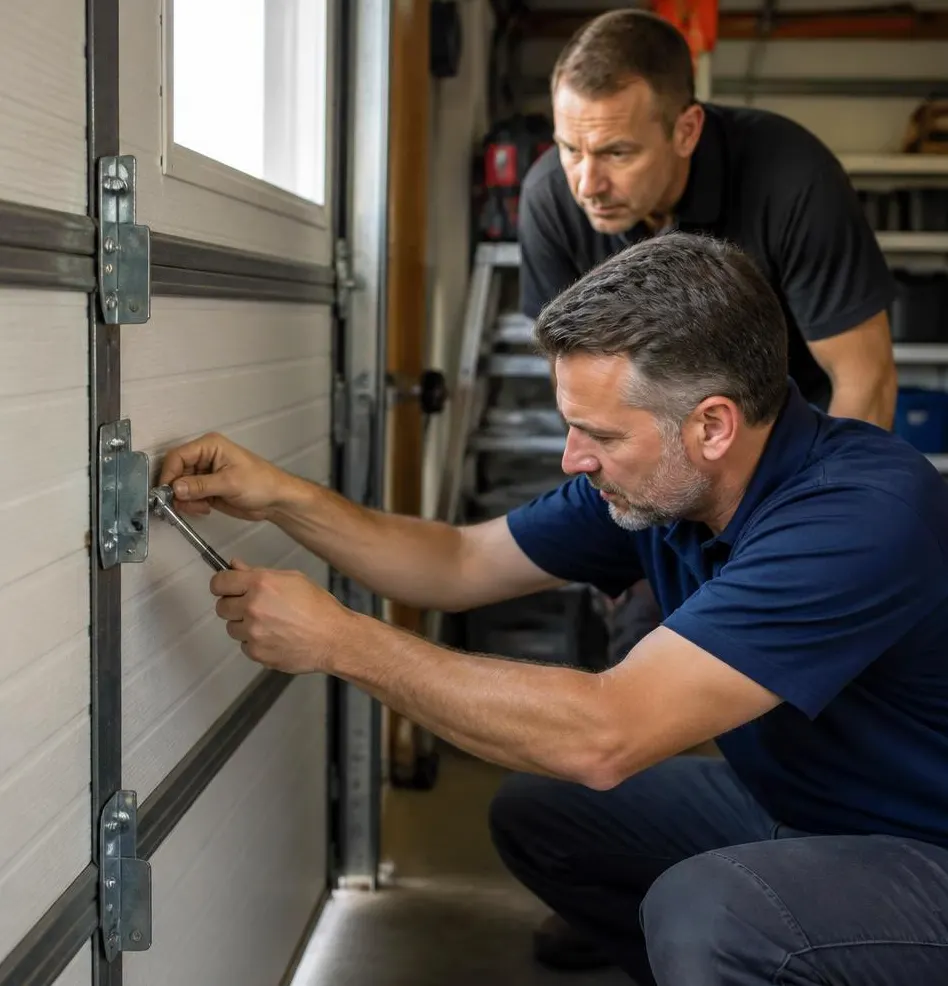
It usually starts the same way. One of you presses the remote, the door goes down three-quarters of the way, then shoots right back up like it hit something invisible. Or it closes but comes down with a bang that rattles the windows. One spouse says "just turn up the force, it's being too sensitive." The other says "don't touch it, you'll break something." You're both standing in the garage at 9pm staring at a little plastic panel with two dials on it, and neither of you actually knows what those dials do.
Here's the answer, so you can stop guessing.
What Travel Limits Actually Control
Travel limits tell the opener exactly how far to move the door in each direction before it should stop. There's an up limit and a down limit. When these are set correctly, the door opens fully and stops on its own, and closes all the way until it meets the floor and stops—without the motor straining after it's already done moving.
When travel limits are off, you get very specific symptoms:
- Down limit set too short: the door stops a few inches above the floor and never fully closes, leaving a gap.
- Down limit set too long: the opener keeps trying to drive the door into the floor after it's already closed, which strains the motor and can bend the bottom panel over time.
- Up limit set too short: the door doesn't open all the way, so you duck or clip your mirror pulling in.
- Up limit set too long: the door tries to keep opening after it's already at the top, straining the opener and sometimes popping the door off its track.
What Force Settings Actually Control
Force is different. It controls how much push or pull the opener is allowed to use to get the door moving and keep it moving. Every garage door opener built since the mid-1990s is required to have an auto-reverse safety feature: if the door meets resistance while closing, the opener is supposed to stop and reverse instead of continuing to push through it. The force setting is what tells the opener how much resistance counts as "something is blocking this" versus "this is just normal friction."
Set the force too low, and the door reverses on its own for no obvious reason—a little resistance from a stiff hinge or a cold, stiff spring is enough to trigger it, and the door bounces back up every time.
Set the force too high, and the opener stops treating resistance as a warning. It just pushes harder. That's the setting that gets quietly cranked up because "it keeps reversing and we're late," and it's the one that causes real damage, because now the opener will force the door through things it should have stopped for: a frozen bottom seal stuck to the slab, a bent track, a toy under the door, even a hand or a pet. It also keeps running at full strength against a spring that's losing tension, which wears out the opener's gears and motor faster than normal use.
Why the Seasons Make This Worse Right Now
As the weather turns colder heading into winter, this is exactly the time of year these settings get tested. Cold temperatures stiffen the lubricant on rollers and hinges, so doors naturally need a bit more force to move smoothly first thing on a frigid morning. Ice and salt buildup on the track or a frozen weatherstrip seal add resistance right at the bottom of the travel, which is precisely where auto-reverse is supposed to catch problems. If the force was cranked up back in summer to stop a reversing issue, that same high setting is now pushing through icy resistance it should be stopping for. That combination—high force plus winter stiffness—is a common reason openers burn out or doors get damaged in December and January rather than July.
How to Check Which One You Actually Have
Before adjusting anything, watch the door through a full cycle and note exactly where the problem happens:
- If the door reverses at the same spot every time, a few inches before fully closed, that's almost always a travel limit issue, not force.
- If the door reverses at random points, or only on cold mornings, that's more likely force being set too sensitive for current conditions.
- If the door slams the last few inches instead of settling down slowly, check whether the opener's close-speed or force is set high, but also check the door balance—a door that's out of balance will drop fast near the bottom no matter what the opener is set to.
Most openers have a small force and limit adjustment panel near the back, usually with dials or buttons and simple arrows; the owner's manual (or the model number stamped on the unit, searched online) will show the exact procedure. Adjust in small increments and test after each change. Never bypass or disable the auto-reverse safety feature to stop a reversing problem—it exists for a reason, and tampering with it is one of the few truly non-negotiable rules in garage door work.
When It's Not the Settings At All
Here's the part that ends most of these arguments: if you have to keep turning the force up every few months just to get the door to close, the opener isn't the problem. Something mechanical is fighting it—worn rollers, a bent track, rusted hinges, or a spring that's lost tension and isn't helping lift the door anymore. Springs and hardware take a beating from the seasonal swings here, humid summers followed by hard winter cold, and they wear unevenly. Turning up the force just hides a worsening mechanical problem until the opener itself fails or the door comes off track.
When to Call Darien Garage Door
If you've checked the obvious things and the door still reverses, slams, or won't travel correctly, it's worth having it looked at rather than continuing to adjust dials. Darien Garage Door can diagnose whether it's a simple limit and force recalibration or a sign of worn springs, rollers, or track damage underneath. Our Opener Repair & Installation service handles the electronics and settings side, while Garage Door Maintenance covers the mechanical wear—lubrication, balance checks, and hardware inspection—that often turns out to be the real reason the settings keep drifting.
If your door in Darien, IL is reversing, slamming, or just not acting right heading into winter, call Darien Garage Door and we'll find out whether it's the opener or the door before the cold makes it worse.